The RACER Mailbag, August 12
Welcome to the RACER Mailbag. Questions for any of RACER’s writers can be sent to mailbag@racer.com. We love hearing your comments and opinions, but letters that include a question are more likely to be published. Questions received after 12pm ET each Monday will be saved for the following week.
**When Formula 1 takes its summer vacation, so does our F1 writer. Chris Medland is on a well-deserved break for a couple of weeks, but keep sending your F1 questions in and he'll answer them when he returns.**
Q: The level of sustained dominance that Palou and Ganassi are displaying is otherworldly. The downside is we have been missing the drama of a championship going down to the wire for some time. Is 2026 pretty much done or can we hold out hope the someone will at least make it interesting?
Matt, Dallas, TX
MARSHALL PRUETT: We have five races left, and Palou’s championship lead is big enough to where he could crash out of the next two races on the opening laps, finish 25th and last at Markham and Washington D.C., and still head to the Milwaukee doubleheader with the championship lead in hand.
That’s a sobering thing to ponder if you’re Kyle Kirkwood or David Malukas, who are the only drivers left with the smallest chances of overtaking Palou. Essentially, it’s the need for IndyCar’s current king of street racing – Palou’s won three of four this year – to completely fail through mistakes or bad luck to give Kirk and Davey a shot.
Nashville and Portland were the two places to make inroads on his championship lead, and in both cases, Palou extended his advantage. It’s come down to a numbers game, and if he has anything like a decent run in Canada, the title race is effectively over, barring insane misfortune befalling the No. 10 car.
It’s an obvious-dumb thing to say, but the last thing Kirkwood and Malukas needed was to finish behind Palou at Nashville and Portland. The only thing that matters for them at the upcoming races is to get in front of Palou, period. And there’s a secondary item: They can’t afford to have others win the races and take the big points hauls they need.
If Ericsson wins at Markham, O’Ward is second, and Kirkwood is third while Palou is fifth, yes, the gap will come down, but by a tiny margin that does nothing of significance to change the championship outlook.
For Palou’s closest pursuers, it’s maximum points or bust at Markham and D.C. That’s the only way they stay in the hunt. All Palou needs to do is shadow them and neutralize the effect, so really, it’s max points for the chasers and the need for cartoon anvils to strike Palou on a regular basis.
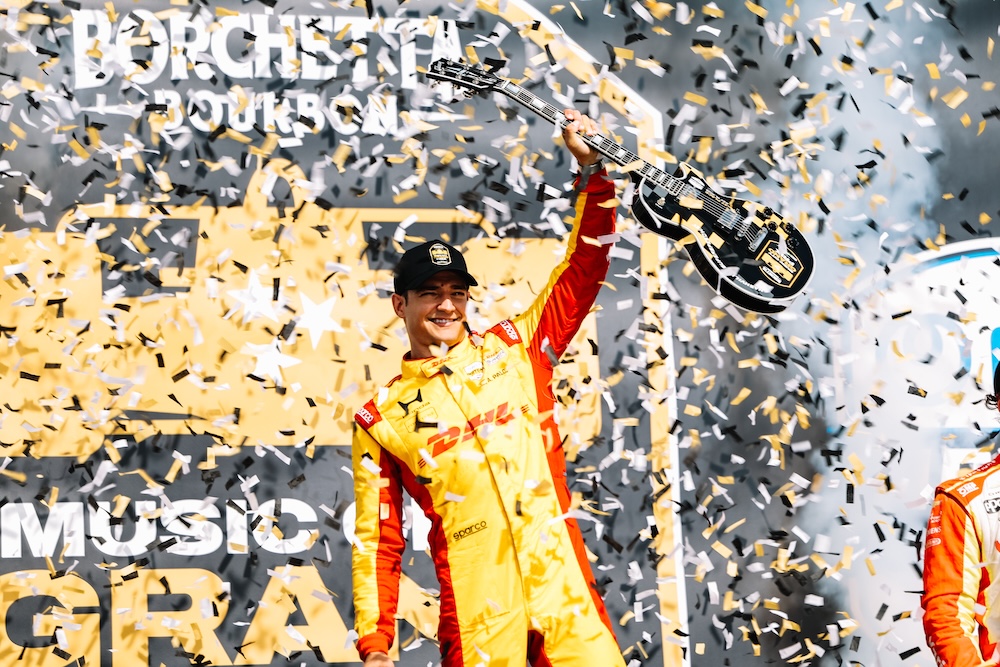
At this point his rivals just have to hope that he slips on some confetti. Joe Skibinski/Penske Entertainment
Q: Philosophical Question: Assuming Christian Lundgaard signs with CGR to replace Scott Dixon, is Chip repeating his classic playbook? In the past, pairing a road-course specialist with a veteran who mastered ovals – Vasser/Zanardi, Vasser/Montoya, Dixon/Franchitti, and now Dixon/Palou – led to championship dynasties. Is Lundgaard poised to be the next 'Ganassi disruptor' alongside Palou, or is CGR's high-pressure environment a massive risk where a ‘bad’ season could send him down the Alexander Rossi path to mid-pack irrelevance?
Ganassi seems to value championships more than Indy 500s. While he wants to win Indy, I think he values championships more, whereas Roger Penske, would (probably) tolerate someone who can win Indy (and a few ovals), but place 11th in the standings.
Tactical Question: In F1, backmarkers regularly write off late-era regulation years to pour resources into next-generation cars. Heading into 2027, the final year of the DW12, do you expect mid-pack IndyCar teams to do the same and under-invest before buying the new IR-28 chassis? Furthermore, do you see IndyCar changing the 2027 non-500 grids to allowing teams to run non-chartered entries in races where space allows to provide teams an opportunity to fundraise with more ‘ride-buyers’?
Henry
MP: My main takeaway on the decision to go with Lundgaard is that it signals Ganassi has prioritized a win-now approach with the No. 9 car and its sponsor PNC Bank. It’s a shift in thinking for the team; when I spoke with Chip late in June, they were going with a proven F2 talent.
As I wrote then, and afterwards, the team had two paths to pursue: a win-now signing like a Lundgaard or VeeKay, or a win-later route with an F2 driver who’d likely need a year or two to learn the tracks and oval racing before they could be expected to become a significant contributor to the program. The win-later option was the most fascinating, since all of the available IndyCar free agents are known quantities. They might level up in the No. 9 car, but have they shown anything to suggest they can match Palou in the 10 car across an entire season?
That’s where the potential with a top-tier F2 driver offered something different. No guarantee that they’d be the next Palou of course, but there was also no years-long IndyCar history to forecast how they’d fare against Palou. At least with the F2 route, there was some mystery involved – undiscovered brilliance, possibly – to eventually arm Ganassi with two Palous.
But thanks to the near total absence of offseason testing, there’s no chance for an F2 driver to mimic what Zanardi and Montoya produced as rookies, since those legends turned thousands upon thousands of miles at all manner of tracks before their first IndyCar races. They were IndyCar and oval rookies in name, only, as a byproduct of all the testing.
Today, an elite F2 driver might win a race or two as a rookie on roads and streets, but it’s a drawn-out process for any driver who’s new to the series to become a complete package, and that’s where the newfound urgency to achieve more with the No. 9 car, in 2027, redirected Ganassi’s original plan. Dixon could win more races before his time in the No. 9 is over, but it hasn’t been a front-running car for more than a year, and I’d bet that played a role in signing Lundgaard.
If the 9 car was right there with the 10, the F2 plan might have been an easier sell, but one victory from its last 41 races is the kind of thing that can lead to a win-now decision.
Couple of other things to consider. Palou arrived at Ganassi as a sophomore in a full state of awe with Dixon, the defending series champion. He listened to everything Dixon said, made use of all the advice, devoured all of his data, and became the team’s new champion.
Lundgaard has the same opportunity to do all of those things, but brings a far more extensive set of IndyCar-specific skills to the team. The holes in his game are much smaller, and with his No. 7 car at Arrow McLaren, he never knows if it will be a rocket or floundering for pace from one weekend to the next. At Ganassi, the team and the car he’s taking over is almost always ready to run towards the front, and that’s a game changer.
He’s also never had a teammate like Palou. He’s capable of beating O’Ward about half the time, which nobody had done to Pato prior to Lundgaard’s arrival, but what will that look like while facing IndyCar’s most complete threat? Does he level up and become the first teammate to out-run Palou on a semi-regular basis? Does he get humbled by Palou? How does Palou react to having a potential threat like Lundgaard, and does he start to stumble mentally if Lundgaard brings constant heat with the 9 car? This is going to be a fascinating character study.
I wouldn’t agree with the suggestion that Chip is less focused on the 500 than Roger. Dixon should have three or four 500 wins by now. Palou won the thing in 2025, has a couple of poles, and is an every-year contender for victory. Lundgaard isn’t the same oval performer as Dixon, obviously, but that’s what the team will look to resolve with haste.
Most of the midfield teams budget R&D programs through the first half of the season, so I doubt we’ll see much of a change in approach with the IR28 coming online to cause an early abandonment of DW12 R&D.
I don’t expect Penske Entertainment to change its charter policy to allow non-charter cars outside of Indy, but have written about the need to do so here. Half of the teams need all of the money they can raise, and running extra cars on a part-time one-time-only basis in 2027 with the outgoing DW12s is a smart way to do it.
Marshall Pruett
The 2026 season marks Marshall Pruett's 40th year working in the sport. In his role today for RACER, Pruett covers open-wheel and sports car racing as a writer, reporter, photographer, and filmmaker. In his previous career, he served as a mechanic, engineer, and team manager in a variety of series, including IndyCar, IMSA, and World Challenge.
Read Marshall Pruett's articles
Latest News
Comments
Comments are disabled until you accept Social Networking Cookies. Update cookie preferences
If the dialog doesn't appear, ad-blockers are often the cause; try disabling yours or see our Social Features Support.